


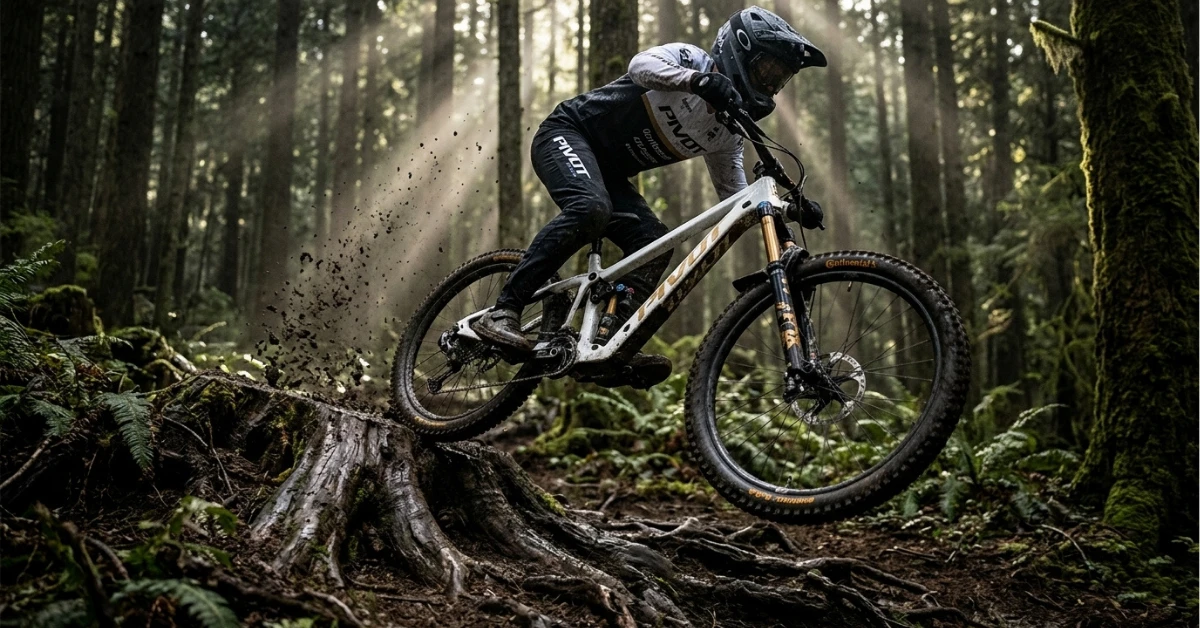
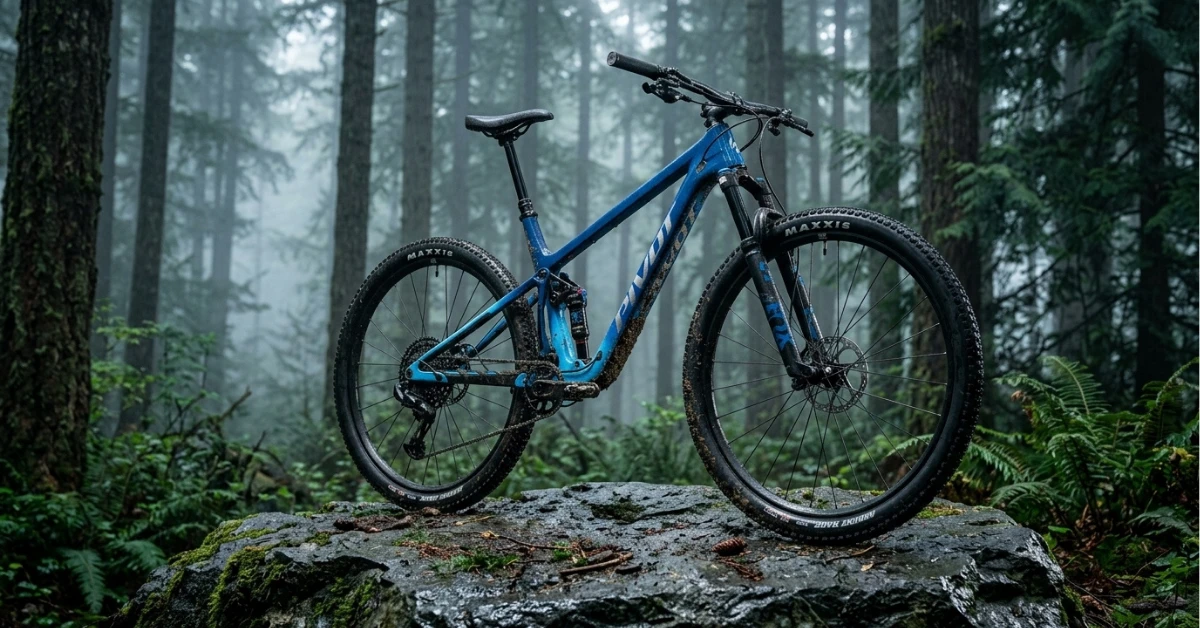
There is a massive lie circulating in the mountain bike industry right now. Brands want you to believe you need a 140mm-travel enduro couch to survive basic singletrack. But after spending three months thrashing the new Pivot Mach 4 SL through the slick, root-choked forests of the Pacific Northwest, I am calling their bluff. This feathery cross-country scalpel punches so far above its weight class that it legitimately made my daily trail rig feel like a sluggish tractor. You do not need more suspension. You need better suspension.
The Granular Specs: No Marketing Fluff
I tear down every test bike I receive. I want to see the bearing seats, check the factory grease, and measure the real numbers. According to the official geometry chart, the numbers below reflect the 120mm fork setup. Here is exactly what you get when you unbox the Mach 4 SL.

| Component / Metric | The Hard Numbers |
|---|---|
| Frame Material | Proprietary Hollow Core Carbon Fiber (1,930g w/ shock) |
| Front Travel | 120mm (Fox Factory 34 Step-Cast, FIT4 Damper) |
| Rear Travel | 106mm or 115mm (Adjustable via Flip-Chip) |
| Rear Shock Specs | Fox Factory Float, 190x45mm (8x30mm hardware) |
| Hub Spacing | Boost 12x148mm Rear (NOT Super Boost Plus) |
| Bottom Bracket | PF92 Press-Fit (Direct machined carbon bearing seats) |
| Chainline & Ring | 52mm or 55mm compatible (Max 36T ring) |
| Head Tube Angle | 66.7 degrees (with 120mm fork) |
| Reach (Size Large) | 462mm |
| Seat Tube Angle | 74.7 degrees |
| Max Tire Clearance | 29 x 2.4″ |
| Brake Mount | 160mm native (Accommodates up to 180mm with adapter) |
| Dropper Insertion | 365mm max depth (Size Large frame) |
How dw-link Actually Feels in the Dirt
I absolutely hate pedal bob. Nothing kills the stoke faster than feeling your wattage get sucked into a spongy rear shock on a brutal 15-percent fire road climb. Dave Weagle’s dw-link suspension design has a legendary reputation for a reason. The anti-squat characteristics on this rig are violently efficient. When I stand up and hammer on the pedals, the rear tire digs into the dirt like a claw.
But here is the kicker: The suspension does not completely lock up under heavy chain tension. I took this bike up a miserable, rain-slicked root ladder outside of Bellingham. Instead of ricocheting off the wet wood, the rear wheel tracked the ground perfectly. The suspension stays active enough to hunt for traction, but firm enough to rocket you forward.
When you drop the saddle and point it downhill, the lateral stiffness of the dual-upright swingarm makes cornering feel telepathic. You point the front tire, and the rear end snaps into line immediately.
The Reality Check: What the Spec Sheet Hides
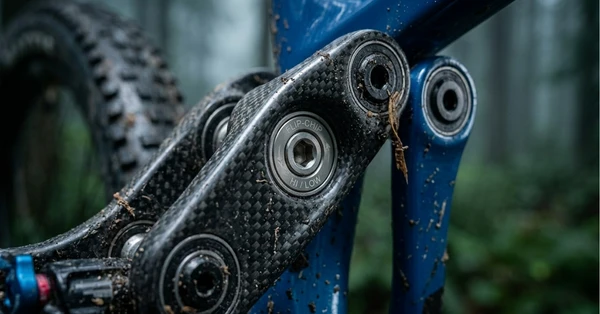
No bike is perfect. I spend half my life in the garage bleeding brakes and swapping derailleurs, so I notice the small mechanical headaches. The internal cable routing ports on this frame are an absolute nightmare. Forum mechanics have been screaming about the incredibly tight clearance around the bottom bracket shell. It turns a simple rear brake hose swap into a bleeding-knuckle swearing match.


Then there is the rubber. Pivot specs the Maxxis Rekon Race tires from the factory. Those might be fine for dusty hardpack in Arizona. But in the wet, sloppy mud of the PNW? They are basically bald ice skates. You will wash out the front end instantly. Swap them immediately if you live anywhere with actual weather.
Finally, do not expect a forgiving ride. Pinkbike’s review of the Mach 4 SL explicitly noted that the suspension tune is undeniably firm and race-focused. The damping is built strictly for World Cup wattage, not Sunday cruising.
If you want to see the suspension tech and flip-chip explained by Pivot’s own mechanics, check out this Pivot Mach 4 SL Tech Deep Dive.
The Financial Damage & Availability
Speed is never cheap. The entry fee for this carbon chassis starts at $6,199 USD for the Ride XT/SLX build. That gets you the engineering and the suspension platform, but you carry some extra component weight.
If you want the absolute pinnacle of current mountain bike tech, prepare to empty your savings account. The Team XX SL Eagle Transmission build maxes out at a wallet-melting $11,599 USD. That price tag is completely absurd for a casual rider. But for privateer racers looking to shave actual seconds off a lap time? It is simply the cost of doing business.
If you want to see this bike in action on the dirt, check out this Mo and Hannah Mach 4 SL test ride. It breaks down how the new geometry and travel flip-chip actually feel when you are pushing it hard on the trail.
The Alternatives: Epic World Cup vs. Supercaliber
You are probably staring at the Specialized Epic World Cup or the Trek Supercaliber as alternatives. Let us get real about those options. The Epic World Cup is a torture device on actual trails. Its proprietary shock setup is incredibly harsh, acting more like a hardtail until you hit a massive square-edge rock.
The Trek Supercaliber is brilliant engineering with its IsoStrut design. But it tops out at 80mm of rear travel. Try bringing that down a blown-out descent littered with brake bumps. Your ankles will absolutely hate you.
The Mach 4 SL destroys both of them in versatility. Thanks to that flip-chip and the 120mm fork option, it is a race bike that refuses to act like one when the trail turns steep. I will take the Pivot every single time.
The Cyclist’s Guide: Mach 4 SL Survival Rules

If you drop the cash on this rig, you need to know how to live with it. I have compiled the non-negotiable rules for keeping this machine running flawlessly.
| Action | Why It Matters | Risk If Ignored |
|---|---|---|
| Ditch the Stock Rubber | The Maxxis Rekon Race tires are dangerous in wet conditions. | Washing out the front wheel and snapping a collarbone. |
| Torque the Flip-Chip | Suspension hardware rattles loose on chunky descents. | Destroying the carbon linkage mounts. |
| Use an Internal Routing Tool | The bottom bracket clearance is practically non-existent. | Ruining your brake hose and your weekend. |
| Check Sag Weekly | The dw-link relies on precise 25-30% sag for anti-squat to work. | The bike will pedal like a wet mattress. |
The Dealbreaker: Who Should Walk Away
I am not going to sugarcoat this. If you are looking for a plush, forgiving ride to cruise local fire roads and absorb every small root, walk away right now. This bike will absolutely punish lazy line choices. It is a hyper-focused XC race machine designed to transmit every single ounce of wattage directly to the dirt. That means it also transmits trail chatter directly to your spine. If your local trails are pure, relentless rock gardens and you refuse to stand up on the pedals, you are going to get bounced around mercilessly. Buy a trail bike with 140mm of travel instead.
Busting the “XC Bikes Can’t Jump” Myth
There is this ancient internet myth that cross-country bikes will snap in half if you hit a jump. That advice belongs in 2014. Modern carbon layups have completely changed the game. Pivot machines the bearing seats directly into the carbon fiber, completely eliminating heavy aluminum inserts. This creates a terrifyingly strong chassis. I took this exact rig off a four-foot drop on my local jump line, and the dual-upright swingarm did not even flinch. It handles big hits with zero lateral flex.
The Expert Consensus & My Final Verdict
Do not just take my word for it. The crew over at Bicycling Magazine recently raved that “climbing while aboard the Mach 4 SL felt fast, yet smooth,” calling the dw-link rear suspension a massive asset. I agree with them completely.
Here is my hardline stance. The Pivot Mach 4 SL is the most capable short-travel bike I have ever wrenched on. It climbs like a frightened goat and descends with terrifying precision. Yes, it is wildly expensive. Yes, the cable routing is annoying. And yes, the stock tires are complete garbage in the wet. But once you dial the suspension and swap the rubber, it is absolutely untouchable on the dirt.
Drop into the comments below. Tell me if you think downcountry bikes are replacing traditional trail bikes, or if I am completely out of my mind.
The Cyclist’s FAQ
Is the Pivot Mach 4 SL a downcountry bike?
Yes, but it hides its wild side well. With the 120mm fork and the flip-chip set to 115mm of rear travel, it sits perfectly in the downcountry category. The 66.7-degree head tube angle lets you plow through rock gardens that would terrify a traditional XC rider. It climbs like a pure racer but descends like a short-travel trail bike.
How do you change the travel on the Pivot Mach 4 SL?
The travel adjustment is incredibly fast. You just loosen the shock linkage bolt, flip the asymmetrical chip embedded in the rocker link, and torque it back down. This takes less than five minutes in the garage. You can jump between 106mm and 115mm of travel without altering the bike’s geometry. ### What is the frame weight of the Pivot Mach 4 SL? The raw carbon frame is terrifyingly light. Weighing in at exactly 1,930 grams (4.25 lbs) with the Fox Float shock included, it completely deletes mass from the equation. This is achieved by molding the bearing seats directly into the carbon fiber, avoiding heavy metal inserts.
Does the Mach 4 SL use Super Boost Plus spacing?
No, it does not. Pivot invented the 157mm Super Boost standard for their enduro rigs, but they kept it off the Mach 4 SL. It uses standard 12x148mm Boost rear spacing. This keeps the Q-factor narrow so XC racers can push maximum wattage without throwing off their pedal stroke mechanics.
What is the difference between the World Cup and Standard builds?
It comes down to the suspension stroke length and the fork. The World Cup builds run a shorter-stroke shock yielding either 95mm or 103mm of rear travel, paired with a twitchy 100mm fork. The Standard builds (Team, Pro, Ride) push out 106mm or 115mm of rear travel and run a much more capable 120mm fork. ### Can I put a 130mm fork on the Mach 4 SL? Absolutely. Pivot explicitly designed this chassis to handle a 130mm fork if you want to bump up the capability. Swapping in a longer air shaft will slacken the head tube angle slightly and raise the bottom bracket. This makes it an absolute monster on steep PNW descents.
How does the dw-link suspension climb?
It is violently efficient. The dw-link creates massive anti-squat, meaning chain tension prevents the rear shock from compressing when you hammer on the pedals. You do not even need to use the shock lockout lever on fire roads. It simply refuses to bob while seated.
Are the stock tires tubeless ready?
Yes, the factory Maxxis Rekon Race tires are tubeless ready (TR) and feature the EXO casing. But as I mentioned earlier, they offer zero grip in wet conditions. Pull the tubes out immediately, add some sealant, and if you live in the mud, throw them in the trash for something with actual shoulder knobs.
What size dropper post fits the Mach 4 SL?
Pivot designed a completely straight seat tube specifically to fit long dropper posts. A size Large frame gives you 365mm of maximum insertion depth. This means almost every rider can run a 150mm or 175mm dropper without bottoming out the collar on the frame.
Is the Pivot Mach 4 SL worth the money?
If you just want to cruise green trails with your kids, absolutely not. This is a hyper-focused racing tool, and you are paying for World Cup-level carbon engineering. But if you are tired of lugging a heavy trail bike up the mountain and want a rig that climbs like a rocket ship without terrifying you on the downs, it justifies every single dollar.




Leave a Feedback