Is Your Motorbike's ABS Trying to Kill You?
Blame the internet forums, not the electronics: cornering ABS has quietly saved more riders than almost any other piece of kit in motorcycling history. Here's how it actually works, why the real-world record is overwhelmingly good, and the rare moments it can genuinely catch you out.
Advertisement
Ask around any car park after a track day and eventually you'll hear the story: a rider grabs a handful of front brake mid-corner, the ABS pulses, the bike stands up, and suddenly they're heading for the hedge instead of the apex. The conclusion is always the same — the ABS did this to me. It's a story that spreads fast, gathers detail with every retelling, and is almost always wrong in the one place that actually matters: the part where ABS gets blamed for a crash it was actively trying to prevent.
So let's ask the provocative question properly, out loud, and then answer it honestly. Is your motorbike's ABS trying to kill you? No. It categorically is not. What follows is why — how modern cornering ABS actually works, why the real-world picture points overwhelmingly in its favour, and the small handful of genuine edge cases where it can catch an unprepared rider off guard. Understand those edge cases and you stop fighting the system that is, by any honest measure, one of the best things ever bolted to a motorcycle.
How Cornering ABS Actually Works
Traditional ABS only ever asked one question: is a wheel about to lock? It compared wheel speed against expected road speed and released brake pressure the instant a lockup looked imminent, and it did this on the assumption that the bike was upright. Cornering ABS, now fitted as standard on almost every mid-size and large motorcycle sold new, asks a far smarter question, because it has a great deal more information to work with. A six-axis inertial measurement unit — the IMU — tracks lean angle, roll rate, pitch and yaw many times a second, feeding that data to the ECU alongside wheel speed and brake pressure.
With lean angle in the equation, the system can estimate the tyre grip genuinely on offer at that specific angle, rather than assuming you're sat bolt upright with the full contact patch available. Lean the bike over and there is simply less rubber and less vertical load resisting a locked wheel, so the system tightens its tolerances and steps in earlier and more gently than it would during upright, walking-pace braking. That is precision, not panic — the electronics are quietly recalculating your traction budget dozens of times a second and only ever spending what is actually there.
Crucially, cornering ABS does not merely stop a wheel locking. Many systems also manage lean-angle-dependent brake distribution between front and rear, and the best of them work hand in hand with lean-sensitive traction control to keep the whole chassis settled under simultaneous braking and turning loads — a job no human nervous system can do at the speed the electronics operate.
The Real-World Record: Fewer Crashes, Not More
Strip away the anecdotes and the wider picture is remarkably consistent: insurers, safety researchers and manufacturers who track long-term claims data all point the same direction. Motorcycles fitted with ABS are involved in meaningfully fewer crashes than otherwise comparable non-ABS machines, and the gap is widest in precisely the scenario riders fear most — an emergency stop that goes wrong. The reason is unglamorous but decisive: most riders, under genuine panic, brake later and harder than they believe they do, and a locked front wheel at that moment ends in a low-side almost every single time. ABS simply removes that one specific failure mode from the equation, quietly and repeatedly.
None of which means ABS makes crashes impossible, and no honest reviewer would claim otherwise. It cannot manufacture grip that genuinely isn't there — sheet ice, a diesel spill or a wheel already airborne over a mid-corner bump are still beyond anything a computer can fix. What it reliably does is convert the single most common cause of a braking crash — an unintended front-wheel lockup — into a complete non-event, over and over, for riders who would otherwise never have felt it coming.
Where ABS Genuinely Surprises Riders
The myth doesn't come from nowhere, though, and being straight about where cornering ABS genuinely feels strange is the whole point of this piece. Loose gravel and hard-packed dirt are the biggest offender. ABS calibration is built around a wheel-speed model that assumes a reasonably consistent, high-friction surface; on loose stones that assumption breaks down constantly, because wheel speed naturally fluctuates as small stones roll and shift beneath the tyre. The system can misread that fluctuation as an impending lockup and release brake pressure right when you wanted maximum retardation, extending your stopping distance rather than shortening it. It's exactly why serious adventure bikes ship with a switchable, reduced-intervention off-road ABS mode — and why leaving it in road mode on a gravel track is asking for trouble.
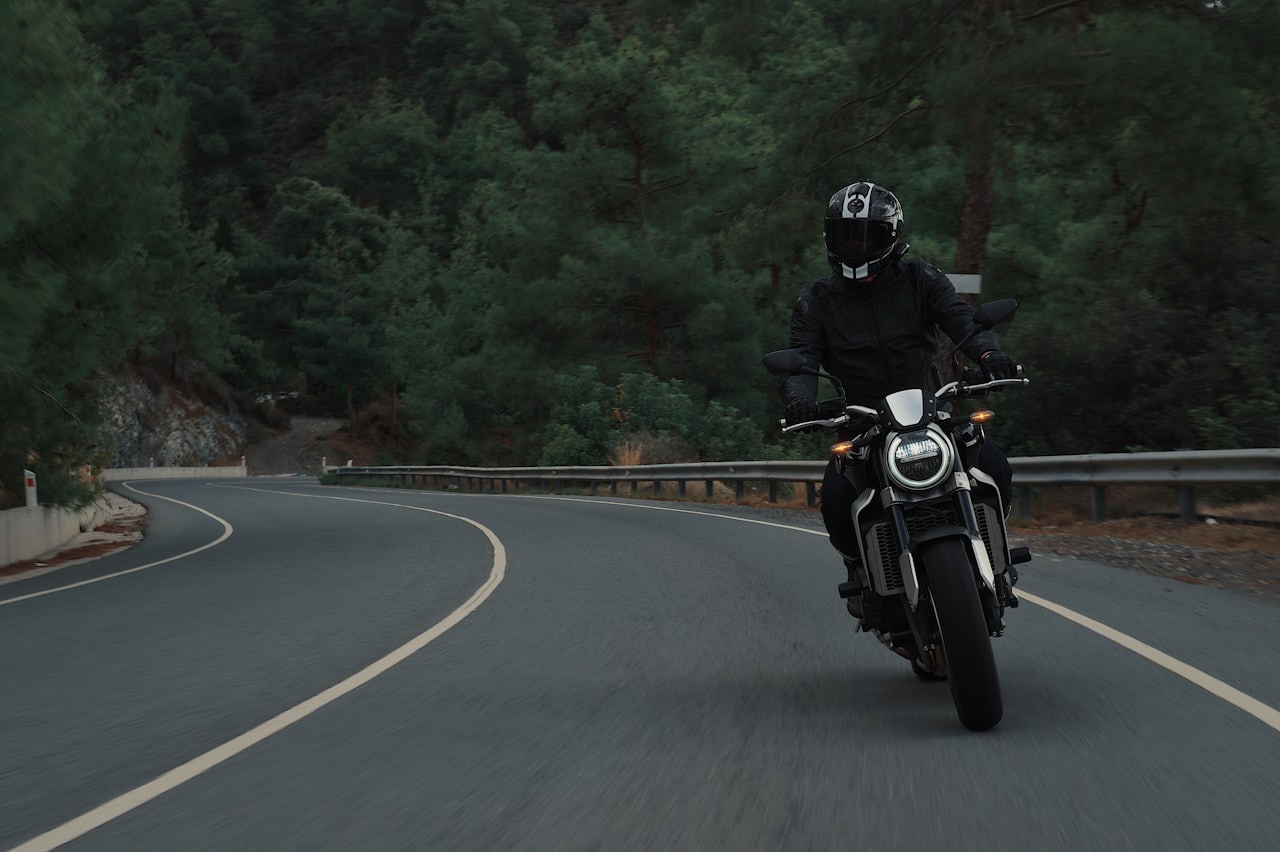
Mid-corner trail braking is the second genuine edge case, and it tends to catch sportier riders rather than novices. Trail braking deep into a bend — carrying a trace of front brake well past turn-in — is a legitimate, widely taught technique, but it asks the system to make its lockup calculation at the exact moment lean angle, load transfer and available grip are all shifting simultaneously. Push that combination right to the edge of what the tyre can actually give, particularly on cold rubber or a greasy patch, and cornering ABS will intervene to protect the front. That intervention — a firm pulse through the lever while you're leaned right over — can feel abrupt to a rider who wasn't expecting it, even though the system is doing precisely what it was designed to do.
A third, smaller surprise crops up when riders swap between bikes: a rear wheel lifting slightly under very hard front braking, or an unfamiliar amount of lever pulsing compared with whatever they rode last. Neither is a fault. It's simply a different calibration philosophy, and the fix is familiarity with your own machine, not distrust of the technology fitted to it.
Cornering ABS has never once tried to kill me — but on at least two occasions, it has very obviously stopped me killing myself.— Hana Kobayashi, Features Writer
Riding With ABS Instead Of Fighting It
The riders who get the most out of modern ABS are the ones who stop treating it as a rival fighting their inputs and start treating it as a grip calculator working on their behalf. That means braking with real intent rather than hesitation: squeeze the lever progressively and with genuine commitment in a true emergency, because the system is built to be leaned on hard, not feathered nervously. Trust the pulse when it arrives — it is information, not malfunction — and resist the urge to snap the lever shut the instant you feel it, because that instinct defeats the entire point of the system.
It also means respecting the two edge cases above rather than resenting them. Switch to a gravel or off-road ABS mode before the tarmac runs out, not after you've already lost the front on loose stones. And if trail braking deep into corners is part of your riding, build that habit gradually on familiar roads or a track day first, and accept that an intervention there is the electronics catching a margin you had already spent — not a machine deciding to work against you.
- Learn where your bike's ABS modes live and switch to gravel or off-road mode before the surface changes, not after.
- Squeeze the front brake progressively and with real commitment in an emergency — ABS rewards decisive input, not hesitation.
- If you trail brake, build the technique gradually on familiar roads or a track day before pushing it near the limit.
- A firm pulse at the lever mid-corner is the system working, not failing — don't snatch the lever shut in response.
- Spend five minutes in an empty car park learning exactly how your specific bike's ABS feels before you ever need it for real.
- Only disable ABS if your bike offers it as a deliberate, understood option — never out of a vague sense that it's "in the way".
Verdict
Your motorbike's ABS is not trying to kill you. On the balance of overwhelming real-world evidence, it is one of the most quietly effective pieces of engineering ever fitted to a motorcycle — a system that has converted countless would-be low-sides into uneventful, forgettable stops, most of which the rider involved never even registered as a near miss.
The edge cases are real, but they are narrow, well understood and entirely manageable: respect loose surfaces, build your trail-braking technique deliberately, and treat every pulse at the lever as useful information rather than betrayal. Learn those few rules and cornering ABS stops feeling like an unpredictable passenger on your motorcycle, and starts feeling like exactly what it is — the best safety net riding has ever built in.